
Almost 10 years after the release of Pokémon Go, hundreds of millions of users have inadvertently built one of the largest real-world image datasets in AI history. Niantic has just confirmed this and is preparing to launch its first commercial app.
Niantic Spatial, the AI company that separated from Niantic in May 2025, states that the data collected through Pokémon Go and other augmented reality apps generated a dataset with more than 30 billion urban images. The company recently announced a partnership with Coco Robotics, a startup that operates around 1,000 delivery robots in cities in the US and Europe.
The Coco robot will use Niantic Spatial's image-based navigation system to move with an accuracy of just a few centimeters, instead of relying on GPS, which is prone to errors in densely populated urban areas with tall buildings.
We have more than one million location points All over the world "that can identify your position with high accuracy. Our delivery robots know exactly where you are, with a margin of error of just a few centimeters. More importantly, we know where you are looking," said Brian McClendon, Chief Technology Officer of Niantic Spatial.
What makes this dataset particularly valuable is the way it was collected. Pokémon Go players do not just walk around with their phones in hand. They scan tourist spots, store facades, parks, and sidewalks from all angles, at any time of day, in all kinds of lighting and weather conditions.
Each frame is accompanied by detailed data about the location, angle, speed, and direction of the phone's movement at the moment of capture. Currently, no mapping company can record the physical world on a similar scale.
Coco's delivery robot uses data directly from Pokémon Go players. Photo: Bloomberg .
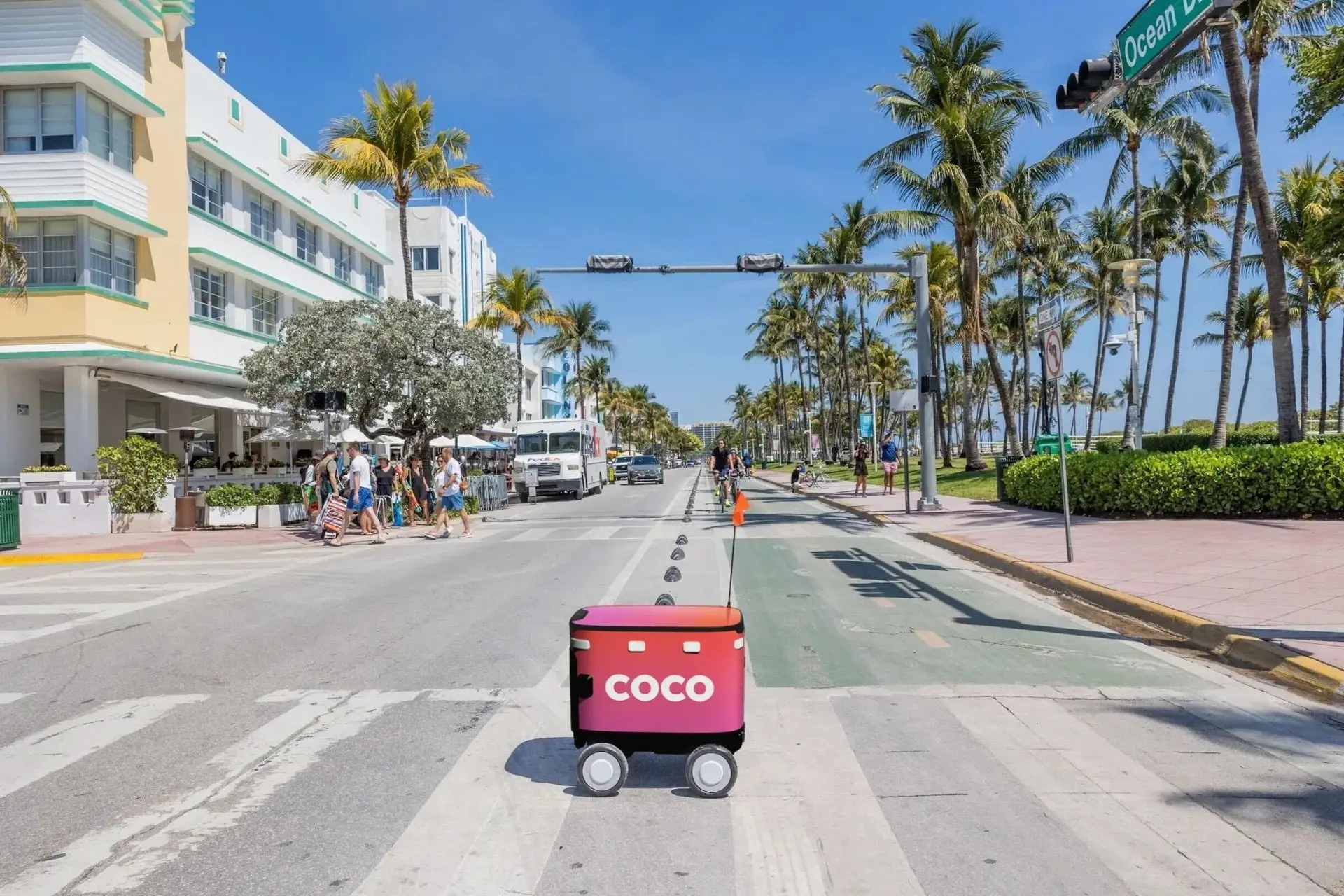
Coco's robot is equipped with four cameras pointed in four directions, moves at a speed of approximately 8 km/h on the sidewalk, and can carry multiple orders at the same time. Coco has already made more than 500,000 deliveries.
To compete with human delivery drivers, the robot needs to reach the exact pick-up point in front of the restaurant and stop precisely at the customer's door. Conventional GPS can have an inaccuracy of dozens of meters in areas with many tall buildings. Niantic's spatial system solves this problem by recognizing the buildings and signs around to determine its location.
However, the incident also raises an important question about users' rights regarding data. Niantic is allowed to do this thanks to Clause 5.2 of its Terms of Service, which authorizes the company to use AR data submitted by users and transfer these rights to third parties.
Players agreed to these terms when installing the app. However, accepting the terms of service and actually understanding what they are agreeing to are two different things. Users can refuse to submit new data, but they cannot delete what has already been sent to the system.
The dataset with 30 billion images is just the beginning. Niantic Spatial is building a new geographic model, with the ambition of creating a system that understands physical space, serving autonomous robots, augmented reality glasses, and spatial computing. The images that players send today to catch Pokémon are becoming the foundation for the next generation of robots.